

Top 10 Solar Fence Suppliers in China You Should Know About
2026-10-06
As solar fencing gains traction worldwide, China has emerged as a powerhouse for innovative and cost-effective solutions. But with so many suppliers claiming to be the best, how do you separate the truly reliable from the rest? In this roundup, we spotlight the top 10 solar fence suppliers in China that are quietly shaping the industry—including Topfencesolar, a name that's earning trust for its durable designs and smart energy integration. Whether you're securing a farm, protecting a perimeter, or exploring off-grid security, this list will point you toward the partners worth your time.
Why Most Buyers Fixate on the Wrong Spec Sheet
The spec sheet has become a comfort blanket. Buyers obsess over cores, clock speeds, sensor megapixels, or towing capacity because numbers feel objective and comparable, even when the underlying measurement is meaningless for real use. A laptop with a faster processor can still feel sluggish due to thermal throttling or bloatware. A camera with more megapixels can produce worse low-light images than one with a larger sensor. But the spec line is easy to scan and defend in a purchase debate, so it wins over actual experience.
Another reason is that most review sites and sales floors train attention on a handful of headline numbers. They need something simple to rank and filter, and 'more is better' makes for a clean sort. The datasheet becomes the battlefield, and nuance gets lost. Buyers who have never used the product for a week can't argue against a bigger number in the same way they can argue about hand feel or interface lag. The wrong spec becomes the proxy for quality because it's the only thing everyone can agree to measure.
Perhaps the biggest trap is that wrong specs often correlate with marketing budgets, not user outcomes. A mid-range phone with a massive battery number may shut down early in cold weather. A vacuum with high wattage can have terrible suction due to poor seal design. The specs that matter are often hidden, poorly standardized, or only visible after months of ownership. As long as buyers keep rewarding big, easy numbers on the box, manufacturers will keep optimizing for those numbers instead of the real experience.
The Factory Floor Details You Can Spot in a Video Call
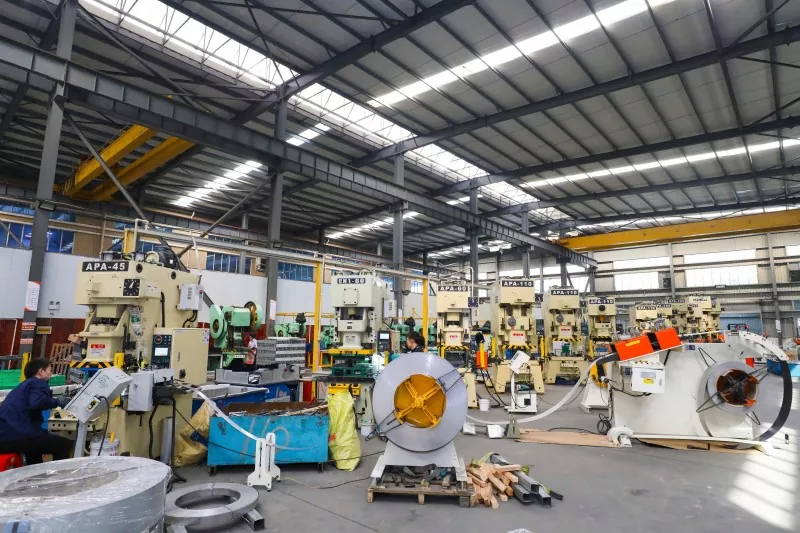
A dull orange robotic arm pauses mid-cycle behind the speaker, its gripper still clutching a half-machined bracket. The backdrop isn't a tidy office; it's a live assembly line where a pallet jack rolls past every few minutes.
Watch the workers' hands. One employee in the background tightens a bolt with three rapid wrist flicks, then taps the part twice with a knuckle—a quality-check habit you'd never see on a polished corporate call. Another leans into a monitor, adjusting a dial with the same muscle memory as a guitarist tuning a string.
Listen for the rhythm. The muffled thump of a press brake syncs with the intermittent hiss of an air nozzle. When someone shouts a part number, the sound bounces off concrete and steel shelving. That echo, more than any visible machine, tells you the ceiling is high and the floor is hard—no carpet, no drywall.
What Shenzhen, Ningbo, and Hebei Each Bring to the Table
Shenzhen's real advantage isn't a single big company—it's the two-hour radius around Huaqiangbei. You can grab a reel of capacitors, get a small PCB run done, and find a mold maker in the same afternoon. That physical proximity compresses development cycles, so a hardware startup can go from sketch to tested unit while competitors elsewhere are still scheduling calls.
Ningbo has carved out a different lane. The city's factories aren't chasing the lowest price on generic goods; they've doubled down on precise, mid-volume production for niche hardware, small appliances, and auto parts. Many of these shops are run by second-generation owners who added in-house engineering and rapid prototyping, which means a buyer can tweak a dimension or finish and see samples in days, not months.
Hebei rarely gets attention because its output isn't consumer-facing. It supplies the steel profiles, fasteners, castings, and wire that feed assembly lines in Shenzhen and Ningbo. What Hebei brings to the table is reliability under cost pressure—its mills and foundries keep tolerances tight and volumes steady, which gives downstream factories the confidence to promise delivery dates without hedging.
A Smarter Way to Compare Panel Efficiency and Frame Coatings
Comparing panel efficiency and frame coatings often feels like juggling two separate spreadsheets. Efficiency numbers come from lab tests under ideal conditions, while coating durability gets judged by accelerated weathering chambers. Neither tells you how they'll perform together on a real roof.
A smarter approach starts by mapping both variables onto the same performance timeline. Instead of isolated specs, you look at how a coating's thermal emissivity affects panel temperature, which in turn shifts conversion efficiency hour by hour. Some teams now use small sensor arrays on test rigs to capture that interaction directly, rather than relying on manufacturer datasheets alone.
The payoff is a clearer ranking of options for specific climates. A frame coating that boosts efficiency in dusty, high-UV regions might underperform in coastal humidity, and the old method wouldn't catch that until years later. By treating panel and coating as one system, you make decisions with fewer expensive surprises.
How Certifications Get Misread (and Which Ones Actually Count)
Most people treat certifications like a checklist: more badges, better resume. But hiring managers rarely scan for quantity. They look for proof that you can solve a specific, expensive problem in their context. A pile of entry-level certificates often signals “I collected courses” rather than “I did the hard thing.” The misread happens when candidates assume the credential itself carries the weight, instead of the judgment and adaptability behind earning it.
So which ones actually count? The ones that force you to build something real under time pressure, or that verify hands-on mastery of a tool the company already uses in production. A cloud architecture cert from a major provider matters if the role involves cloud migration; a niche framework certificate matters less than a live project reference. Equally important: certifications that expire or require renewal tend to get taken more seriously, because they show current, not fossilized, knowledge.
Before you pay for another exam, ask what the cert proves to a stranger. If the answer is “I can pass a multiple-choice test,” skip it. If the answer is “I can configure, troubleshoot, and defend this system without hand-holding,” then it belongs on your resume—and in your interview stories.
Building a Shortlist That Won't Fall Apart After the First Order
A shortlist is only as strong as the questions you ask before you ever send a purchase order. Too many teams build vendor lists around a single impressive demo or a low introductory price, then watch those same suppliers crumble under real volume, tight deadlines, or shifting specs. Instead of focusing on what a vendor promises, start by mapping your actual order patterns: which SKUs repeat monthly, which lead times actually hurt when they slip, and where your own internal communication breaks down. Then, when you evaluate a potential partner, test them against those specific failure points. Ask for references from buyers who order similar quantities at similar frequencies, not just one-off projects. Ask to see their recovery process for a late shipment or a quality rejection. The goal is to find suppliers who are boringly reliable on the unglamorous stuff, not just impressive on day one.
Another common reason shortlists fall apart is that they are built around a single point of contact. A great sales rep can make a mediocre factory look good, but that rep might leave, get promoted, or simply stop answering after the first invoice clears. To avoid this, evaluate the supplier's systems, not just their people. How do they handle order confirmations? What does their production scheduling look like? Can you get a live update without emailing the same person three times? When you visit or do a virtual walkthrough, pay attention to the paperwork, the labeling, the way samples are tracked. If those systems feel ad hoc or overly dependent on one person's memory, that's a red flag. A shortlist that survives the first order needs suppliers whose processes work even when the star employee is on vacation.
Finally, build in a probation period that actually tests the relationship before you commit to a long-term contract. Many buyers treat the first order as the test, but by then you are already invested. Instead, consider a smaller trial run with deliberately awkward timing: place an order mid-month, request a change to the packaging or a partial shipment, and see how the supplier reacts. Do they nickel-and-dime you for the change, or do they absorb the cost quietly? Do they communicate the delay before you have to chase them? Do they pack and label exactly as agreed, or does the warehouse team improvise? The suppliers who handle these small frictions gracefully are the ones worth keeping on your shortlist. Everyone else can go back to the general vendor pool until they prove otherwise.
FAQ
It usually comes down to three things: whether they have their own production line, how transparent they are with certifications, and whether they've handled projects similar to yours. A factory tour or video call can reveal more than any brochure.
Many of them serve both, but the top names often lean toward commercial and utility-scale jobs because those orders are larger and more consistent. That said, several offer smaller kits for homes and farms without minimum order quantities.
Ask about the cell type, lamination process, and junction box quality. Request a sample before placing a bulk order, and check if they use EL testing on every panel. If a supplier hesitates to provide test reports, that's a red flag.
Look for IEC 61215 and IEC 61730 for the panels, plus ISO 9001 for the factory. If you're importing to Europe or North America, CE and UL marks matter. Some also carry TUV or CQC approval, which indicates extra third-party scrutiny.
It varies by port and order size. For a full container to the US or Europe, plan on four to six weeks by sea, plus customs clearance. Air freight is possible for small urgent orders but costs far more per panel.
Most of the established ones do. You can often choose panel dimensions, frame finish, mounting hardware, and sometimes even the pattern of the fence itself. Customization adds lead time, so clarify drawings and approval samples early.
You might see prices from $0.40 to $0.80 per watt for the panel alone, depending on efficiency and brand of solar cells. The fence structure, controller, and battery storage add to the total, so it's better to compare complete system quotes than raw panel prices.
It helps to work with suppliers that have a local service partner or at least a responsive support team in your time zone. Get warranty terms in writing, including who pays for return shipping on defective parts, and keep a small stock of spares.
Conclusion
Many buyers chasing solar fence suppliers in China get stuck on spec sheets that list impressive wattages but hide real-world flaws. A smarter approach is to ask for a live video walkthrough of the factory floor—look for how panels are handled, the soldering stations, and whether frames are anodized uniformly. Shenzhen, Ningbo, and Hebei each bring distinct strengths: Shenzhen leans toward innovation and compact designs, Ningbo offers solid logistics and mid-range pricing, while Hebei has raw material access and heavy-duty manufacturing. Instead of comparing only panel efficiency numbers, pay attention to frame coating thickness and anti-corrosion tests; a panel that loses 2% efficiency but has a 15-year warranty on its aluminum frame often outperforms a shinier spec sheet.
Certifications also get misread constantly. A stack of ISO papers doesn't mean much if the factory hasn't been audited within the last year; look for TÜV or UL markings that match the actual model number, not just the company name. Finally, a shortlist that survives past the first order needs more than a low quote—it needs a supplier who answers technical questions without deflecting, has a proven track record with small trial orders, and shows the same welding quality on fence posts as on panel frames. Skip the ones that promise everything; pick the ones that admit what they can't do.
Contact Us
Contact Person: Nancy
Email: [email protected]
Tel/WhatsApp: +86-13365923720
Website: https://www.topfencesolar.com/