
Sanitary Ware Vertical Lift Plating Equipment Solutions for Enhanced Productivity and Finish Quality
2026-10-18
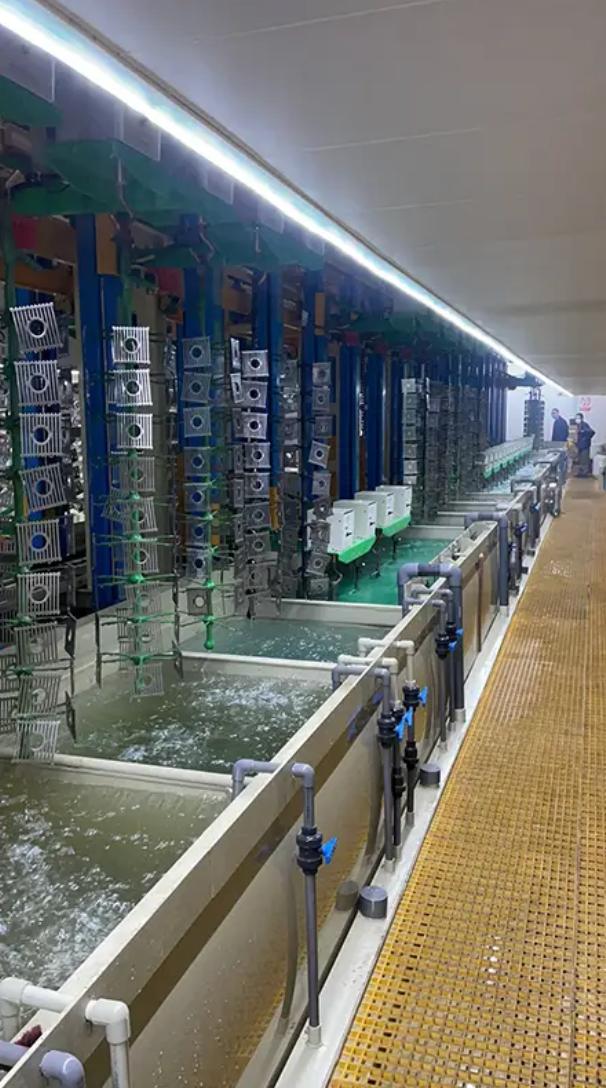
If your sanitary ware plating line still relies on horizontal racks, you're probably leaving both output and surface consistency on the table. Switching to a vertical lift configuration can dramatically improve how parts are positioned, drained, and coated — yet not all vertical systems deliver the same results. At Junda, we've engineered vertical lift plating equipment specifically for sanitary ware, targeting the two metrics that matter most: higher productivity and a flawless finish. Here's what that looks like in practice.
Rack Contact Failures That Quietly Erode Plating Consistency
Loose or worn rack contacts rarely announce themselves with a sudden stop. Instead, they nibble at the edges of your process. A spring that has lost its temper, a tip smeared with dried chemistry, or a hook that no longer seats firmly against the part — each one introduces a tiny, intermittent resistance in the circuit. The rectifier still reads the same voltage, the tank still bubbles, and the line keeps moving. But at the part level, the current density shifts just enough to matter. High-current areas begin to starve while neighboring points over-plate, and before long, the thickness distribution drifts outside the range your customer actually checks.
The erosion is easiest to spot in the data, not in the tank. If your control chart shows a widening spread in thickness readings from the same rack position over consecutive runs, suspect the contacts. Watch for parts that plate fine on Monday, thin on Tuesday morning, and acceptable again after a mid-shift rework. That pattern — inconsistency without a clear chemical cause — often points to a rack tip making just enough contact to carry the load sometimes, but not every time. Fixtures that flex under heat, hooks that have been straightened and rebent too many times, or contacts fouled by a thin layer of drag-out are classic culprits. They don't fail outright; they fail probabilistically.
Left unaddressed, these marginal connections quietly train your operators to accept variation as normal. A plater nudges the rectifier up “to help the thin spots,” which overdrives the good contacts. Another operator adds a second hit on the rack, masking the root cause while adding cycle time. The fix is less glamorous than a bath overhaul: pull a few suspect racks, measure resistance lug-to-part under load, and replace springs or tips on a schedule rather than waiting for a visible failure. Rack maintenance is not a repair task — it is a consistency control, and ignoring it lets small contact losses become a permanent tax on your plating uniformity.
Tuning Vertical Stroke Length to Eliminate Shadowing on Deep-Draw Faucets
On deep-drawn faucet bodies, the transition from the base flange to the neck rarely follows a straight line. Mechanical finishing heads that run a fixed vertical stroke can leave a soft, shadow-like band exactly where the contour starts to tighten. This is often mistaken for a polishing defect, but the actual cause is the reversal point of the stroke. Every time the head changes direction at the top or bottom of its travel, it briefly slows down and changes contact angle. If those reversal points sit inside a curved zone, the abrasive cuts differently, leaving a subtle difference in surface reflectance that shows up as shadowing under showroom lighting.
Instead of applying one stroke length across the entire faucet, the vertical travel needs to be segmented according to the part's profile. For the lower flared section, shorten the upward reversal so the head stops just before the diameter starts to reduce sharply. For the neck, allow a slightly longer stroke but keep the lower reversal above the base transition. On a typical deep-draw kitchen faucet with a flared base and narrow neck, moving the upper reversal point down by 2–4 mm often removes the dull ring above the escutcheon. The adjustment should be made with production abrasives and pressure, not on a clean test piece, because the contact patch deforms slightly under load and shifts the effective stroke boundary.
Drag-Out Recovery Methods That Offset Rising Chemical Costs
Drag-out losses often go unnoticed until the monthly chemical invoice lands with a thud. Instead of passively accepting that a percentage of every bath ends up rinsed down the drain, many finishing operations are turning to simple recovery loops. A well-placed static rinse tank after the process bath can capture as much as 50–70% of the carryover, and when that rinse water is used to top up the heated bath, the chemistry returns to work rather than heading to waste treatment. This isn't a complicated engineering project—just a shift in plumbing and mindset.
Pairing drag-out recovery with evaporation control changes the economics further. Hot process tanks lose water faster than chemicals, so returning drag-out rinse water to the bath also reduces the need for fresh makeup water. Some shops install a small still or atmospheric evaporator to concentrate the recovered rinse, turning a waste stream into a concentrated replenishment solution. The key is matching the recovery rate to the actual drag-out volume; over-concentrating can throw off bath balance, so a basic titration schedule keeps everything in check.
Beyond the direct savings, these methods cut wastewater treatment loads and sludge disposal costs, which often rise in step with chemical prices. A line that recovers just 30% of its drag-out can see a noticeable drop in both chemical purchases and neutralization chemicals. It's a quiet kind of savings that doesn't show up on a spec sheet but shows up on the P&L month after month.
Current Density Mapping for Zinc Alloy Bathroom Components
Electroplating zinc alloy bathroom components presents a recurring challenge: complex geometries such as faucet bodies, escutcheons, and shower arms rarely receive uniform current. The distribution of current density across a part's surface directly dictates where metal deposits faster or slower. At sharp edges and outer corners, high current density creates overly thick, sometimes burnt deposits. Recessed areas and internal threads, by contrast, may receive so little current that the plating layer is dangerously thin or absent.
Mapping current density starts with either physical measurement or simulation. A common practical approach uses a specially shaped probe or a segmented cathode to record local current values at multiple points across a zinc alloy fixture. Finite element analysis has become equally useful, offering a visual heat map of current flow before any actual plating bath is prepared. These maps reveal problematic zones: the underside of a spout, a deep screw boss, the narrow gap behind a handle escutcheon. Once those cold spots are identified, adjustments such as repositioning anodes, adding auxiliary anodes, or installing non-conductive shields can redirect current more purposefully.
The payoff from this mapping work is often seen in reduced rejection rates. When current density is balanced, deposit thickness becomes predictable, and corrosion resistance improves in the very places where bathroom hardware is touched most. For zinc alloy substrates, which are less noble than the plated layer, consistent coverage also prevents localized galvanic attack if the plating is scratched. This kind of data-driven fine-tuning shifts plating from guesswork to a repeatable process, even for ornate or deeply contoured designs.
Automating Load Cycles Without Overcomplicating the Line
Many factories hesitate before adding automated load cycles, assuming the line will need a full redesign. Yet small, self-contained loading cells can slot into existing conveyor paths with nothing more than a bracket and a few sensors. The trick is to treat the loader as a removable module rather than a permanent fixture.
Instead of chasing high-speed robotics, a simple pneumatic slide or a stepper-driven pusher often handles the repetitive pick-and-place motion. Standardized trays and alignment pins let operators swap product types in minutes without reprogramming. This keeps the automation invisible to the rest of the line, so changeovers stay quick and maintenance stays low.
The real payoff shows up in reduced manual handling and fewer dropped parts. Operators stop babysitting the same motion every cycle and focus on upstream quality checks. And because the loader uses off-the-shelf components, spare parts sit on a shelf rather than in a custom catalogue.
Agitation and Filtration Layouts That Prevent Pitting on Cast Spouts
On the foundry floor, the way you arrange agitation and filtration around cast spouts often decides whether a batch survives inspection or heads straight to scrap. Pitting along the spout surface rarely stems from a single cause; it emerges from chaotic metal flow, trapped dross, and uneven thermal gradients. A layout that holds the spout in a slight downward tilt during filling, paired with a porous ceramic filter seated just before the narrow section, forces the melt into a laminar path while stripping out oxide skins. Operators who have struggled with recurring pits notice the difference within the first few pours: the spout stays cleaner, and the telltale speckling disappears.
Agitation plays an equally direct role. Rather than relying on violent stirring that whips air into the metal, a slow rotary motion induced by a low-frequency induction coil placed beneath the spout keeps the alloy homogeneous without creating turbulence. The key is timing—agitate during the final third of the pour, then let the stream settle for three to five seconds before it reaches the critical choke point. This gentle mixing redistributes nucleating particles away from the spout walls, where they would otherwise lodge and initiate local corrosion. A well-designed layout routes the filtrate through a multi-stage bed: coarse ceramic foam at the inlet, fine zirconia mesh near the outlet, and a short settling chamber in between.
Field adjustments often make the difference between marginal and reliable results. Shift the filter pack two inches closer to the spout base if pits cluster near the exit lip; raise the agitation frequency by fifteen percent when working with high-copper alloys that form stubborn dross layers. Cast spouts that previously needed weekly rework can run for months once the layout balances agitation energy against filtration surface area. Recording pour temperature, tilt angle, and filter pressure drop for each run builds a dataset that turns pitting prevention from guesswork into a repeatable setup routine.
FAQ
Vertical lift systems let parts move up and down through the bath rather than tumbling or staying static. For faucets, shower heads, and other sanitary fittings that have deep recesses and sharp edges, this movement releases trapped air and forces fresh solution across every surface. The result is a more even deposit in hard-to-reach areas and far fewer rejects from shadowing or gas pitting.
Most vertical lift units are built with adjustable carrier spacing and programmable travel strokes. You can run small aerators and large shower arms back to back simply by changing the stroke length and rectifier settings. Some systems also allow the anode configuration to be swapped quickly, which is useful when switching between chrome, nickel, and copper layers.
The main difference shows up at the edges and inside threaded areas. Since the part is moved vertically at a controlled speed, solution flow stays consistent and metal distribution becomes more uniform. Operators typically see fewer burnt deposits at high current density zones and better leveling in recesses, which means less manual polishing before final inspection.
Yes, if it is sized correctly. The vertical lift cycle is often shorter than barrel plating because loading and unloading can be done on one side while parts are still being processed on the other. Automatic hoists with preset recipes reduce changeover time, and continuous filtration keeps the bath clean enough for long production runs without stopping for sludge removal.
The critical items are the lift guides, tank liners, and anode baskets. Because vertical movement can wear guide rails over time, a monthly lubrication and alignment check is recommended. Anode bags should be inspected weekly for tears, and the rectifier connections need torque checks every quarter. Most faults are caused by loose electrical contacts or contaminated bath chemistry rather than mechanical failure.
Closed-top vertical tanks reduce evaporation losses significantly, and the controlled part movement lowers the amount of brightener and wetter needed for an acceptable finish. In many retrofits, plants report lower heating costs because the tank covers hold temperature better, and drag-out is reduced when parts are lifted and drained directly over the process tank.
Look for two independent limit switches on the hoist, an emergency stop at both loading and unloading stations, and a fume extraction system that activates automatically when the tank cover opens. Anti-fall mechanical locks on the lift carriage are also essential, especially for heavy sanitary ware loads. Leak containment trays and splash guards around the tank edges protect workers from chemical exposure.
It depends on current reject rates and labor costs, but many plants see payback in under two years. The biggest gains come from higher first-pass yield and less rework, since vertical lift plating cuts down on the same defects that require stripping and replating. Reduced chemical drag-out and lower energy use add to the savings each month.
Conclusion
Vertical lift plating lines for sanitary ware often suffer from hidden inefficiencies that quietly eat into both throughput and surface quality. Rack contact failures, for instance, can cause erratic current distribution, leading to patchy deposits on faucet bodies and handles. By redesigning contact points with spring-loaded clamps and conductive carbon sleeves, operators stabilize resistance and restore uniform plating thickness across every rack position. This directly complements stroke tuning: adjusting vertical stroke length to match the deep-draw geometry of modern faucets eliminates shadowing inside spout cavities and behind flanges, where conventional fixed strokes leave thin or burned areas. Combined with drag-out recovery systems that use drip trays, air knives, and counterflow rinses, chemical consumption per rack drops noticeably—often offsetting rising nickel and chrome costs while keeping effluent within discharge limits.
For zinc alloy components like cast spouts and handles, current density mapping becomes an indispensable tool. By measuring local current density across complex profiles, engineers can reposition anodes or apply auxiliary shields so that recessed areas receive adequate deposition without over-plating edges. Automating load cycles with simple PLC-based scheduling—rather than fully robotic systems—avoids overcomplication while reducing manual handling errors and idle time between stations. Finally, agitation and filtration layouts matter just as much as electrical parameters: eductor nozzles angled to sweep dead zones, plus multi-stage bag filters, prevent pitting on cast spouts by removing particulates and breaking up gas bubbles that would otherwise adhere to the surface. Together, these targeted improvements make a vertical lift line not only more productive but also consistently capable of high-gloss, defect-free finishes that sanitary ware buyers expect.
Contact Us
Contact Person: hayyr
Email: [email protected]
Tel/WhatsApp: 8613082110525
Website: https://www.jundaelectroplating.com