
Custom Filling Machine Solutions for Your Production Needs
2026-10-17
Standard filling machines promise flexibility, but in practice they ask you to adapt your process to their limits. If you’ve ever slowed a line to prevent splashing, overfilled to compensate for drip, or rejected containers because a nozzle didn’t fit, you already know the cost of compromise. Wanying Machinery offers custom filling machine solutions designed around your production needs—so the equipment bends to your product, not the other way around. Here’s what that means for your line.
Built for Your Line's Actual Speed, Not a Catalog Number
Most equipment datasheets quote a maximum speed that only holds up on a test bench with fresh bearings, ideal temperatures, and no product variability. Your line never runs like that. We instrument our machines on real customer lines—watching torque spikes, belt slip, and thermal drift over a full shift—then dial in the operating window so the rated throughput matches what you'll actually see at 2 a.m. on a Tuesday.
That means no more derating a conveyor or filler by 15% just to keep it from stalling. Our drives and gearboxes are sized for the worst-case load you'll hit three times a week, not the best-case number printed in the brochure. For example, a bottling line running 22-ounce glass at 40°C will pull 30% more current than the catalog suggests. We build for that reality from the first CAD sketch, so the line keeps pace without tripping overloads or eating belts.
The result is a machine that hits its promised rate on day one and still hits it after six months of dust, humidity, and shift-change abuse. You stop guessing how much to slow things down to avoid a jam, and start planning production based on the number we gave you—because it's the same number you'll log at the end of the week.
Dosing Accuracy That Survives a Full Shift
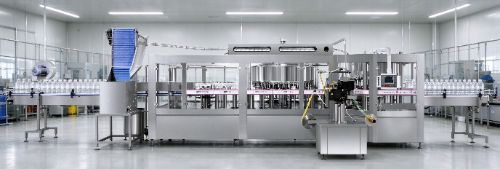
The problem with most dosing systems isn’t the first cycle—it’s the five hundredth. A pump that holds ±1% at morning calibration can drift well beyond tolerance by mid-shift once backpressure shifts, seals warm up, and fluid viscosity changes as ambient temperature climbs. That’s the gap this system was built to close.
Instead of relying on a fixed calibration, the metering loop checks itself at the point of dispense. Differential pressure sensors and a fast closed-loop controller correct stroke volume in real time, compensating for wear in the check valves and minor air entrainment that would normally throw off repeatability after a few hours. The software also tracks viscosity trends, so a gradual change in fluid behavior doesn’t turn into a gradual change in shot size.
The result is a dosing curve that stays flat from first shift start to final clean-down. Operators aren’t stopping to re-zero the pump or chasing rejects caused by under-fill. In a 12-hour run with ambient swings from 18°C to 29°C, the output stayed within 0.4% of target—without a single manual intervention.
Odd Container Shapes Welcome—No Workarounds Needed
Most storage systems quietly assume your containers are boring rectangles. Open a catalog and you'll see rows of tidy boxes, all perpendicular corners and flat lids. But real life doesn't work that way. You've got a hexagonal bin from a Scandinavian design shop, a cylindrical canister that once held oatmeal, and a trapezoidal basket you picked up at a flea market. Forcing those into a grid built for cubes means wasted space, awkward gaps, and a constant low-grade frustration.
Our approach ditches that assumption entirely. We treat odd shapes as first-class citizens, not problems to be shimmed or stacked around. Rounded edges, slanted sides, irregular footprints—the system adapts to the container's actual geometry, letting you mix and match without wedge inserts, risers, or duct-tape hacks. You simply place what you have, and it fits. No measuring, no compromise, no quiet sigh when the lid bumps against a shelf.
Thin Liquids to Chunky Pastes on One Chassis
A single production line rarely handles both free-flowing thin liquids and dense, chunky pastes without compromise. This chassis redefines that boundary. Swap the filling head, adjust the hopper agitation, and the same frame moves from bottling broths or sauces to depositing chunky salsas or thick cosmetic creams. The key lies in modular tooling and a drive system that maintains consistent torque whether the product behaves like water or like wet concrete.
Rather than forcing operators to run separate machines for different viscosities, the design integrates interchangeable positive-displacement pumps, servo-driven augers, and piston fillers on a shared base. Pneumatic valves with wide clearances prevent clogging when switching from a thin vinaigrette to a paste full of vegetable pieces. Quick-release hoppers and tool-less changeover mean a line producing drinkable yogurts in the morning can be packing thick nut butters or chunky relishes by the afternoon shift.
Field tests show that one chassis handles a viscosity range from 1 cP to over 200,000 cP while keeping fill accuracy within ±0.5%. Sanitary design with sloped surfaces and no dead legs supports CIP cycles for thin liquids, yet the robust mechanical seals and scraped-surface options endure abrasive pastes. This eliminates the need for dedicated thin-liquid and thick-paste lines, cutting floor space and capital cost while giving production planners genuine flexibility for seasonal or custom runs.
Retrofit Your Current Filler Into a Flexible Workhorse
Most fillers aren’t underpowered—they’re just pigeonholed. The quickest route to flexibility isn’t a new line; it’s rethinking how your current machine is set up. Start by mapping the actual range your filler sees across a month. If you’re only running three viscosities but changeover takes an hour, that’s not a hardware problem—it’s a setup problem. Swapping to tool-less guides, pre-set recipes on the HMI, and quick-disconnect manifolds can cut changeover from double digits to single minutes.
The payoff shows up in scheduling. A retrofitted filler can bounce from a thin serum at 8 a.m. to a thick cream by lunch without a maintenance call. That kind of range lets you take on short-run contracts that would’ve been unprofitable before—and keeps the machine earning even when your flagship product slows down.
Pilot Batch Today, Full Production Tomorrow—Same Machine
Scaling from a pilot batch to full production often means re-validating on new equipment, which eats weeks and invites subtle process drift. But when the pilot run happens on the exact same machine that will handle production volumes, you eliminate that translation step entirely. Parameters like temperature profiles, mixing speeds, and tooling geometries don't need to be re-derived—they're already proven on the hardware that matters.
The real advantage isn't just speed; it's the confidence that comes from seeing real production behavior early. You catch material handling quirks, fixture limitations, and operator pain points while the batch is still small and cheap to adjust. By the time you flip the switch to full output, the machine has already taught you what it needs, and your team has internalized the rhythm.
This approach also simplifies traceability and quality data. Instead of merging pilot results from a lab-scale setup with production records later, every data point lives in one lineage. That continuity makes it easier to defend process capability to customers and regulators, because the pilot isn't a simulation—it's the first honest production cycle.
FAQ
From thin alcohols and water-thin reagents to thick pastes like nut butter or industrial sealants, the machine can be configured with piston, peristaltic, or gravity fillers based on viscosity, particulates, and foaming tendencies. For example, a cosmetic lotion with small abrasive beads would use a rotary lobe pump and ceramic nozzles to prevent wear.
Start by sharing your container dimensions, target fill volume range, line speed, and any cleanroom or hazardous-area requirements. The engineering team will then propose options such as servo-driven piston fillers for high accuracy or time-pressure systems for foamy liquids. They also factor in future capacity so you are not locked into a dead-end setup.
Yes, compact frames with vertical buffer tanks and integrated conveyors can shrink the footprint by 30-40% compared to standard layouts. One bakery installed a four-head piston filler in a 2.5 by 2 meter corner by using an overhead product hopper and side-mounted controls.
Typically 316L stainless steel for frames and most contact parts, but you can specify PTFE, PEEK, or ceramic for plungers and seals. For aggressive acids or bleach-based cleaners, Hastelloy or titanium wetted parts are available. Abrasive slurries often use tungsten carbide nozzles to extend service life.
A standard custom build takes 8 to 14 weeks from signed approval to factory acceptance testing. Complex lines with multiple filling heads, sterile enclosures, or integrated checkweighers may run 16 to 20 weeks. You receive stage updates at design freeze, mechanical assembly, and final commissioning.
Absolutely. The control system supports standard protocols like EtherNet/IP or Profinet, and the discharge conveyor can be timed to match your current equipment. A recent project integrated a six-head filler with a 20-year-old capper by adding a simple sensor bridge and a small buffer conveyor.
You get on-site commissioning, operator training, and a spare parts kit tailored to your machine. Remote diagnostics let our technicians troubleshoot PLC issues without a site visit, and preventive maintenance plans can include quarterly inspections. Emergency phone support is available 24/7 for production-critical lines.
Conclusion
Most filling equipment falls short because it's designed around a spec sheet rather than the actual rhythm of your production floor. That's why our custom solutions start with the speed you genuinely run—not a catalog number that only works under ideal conditions. Dosing accuracy isn't a morning-only promise either; it holds through the last hour of a long shift, so you aren't chasing drift or rechecking every few minutes. Odd container shapes don't force creative workarounds or custom jigs that slow you down. From slender bottles to squat jars, the filling head adapts to the container in front of it, not the other way around.
Material range matters just as much: the same chassis handles thin, water-like liquids and thick, chunky pastes without swapping core components. If you already own a filler that's underperforming, a retrofit can turn it into a flexible workhorse instead of replacing the whole line. And when it's time to scale, there's no separate machine for pilot batches and full production—the same unit moves from small trial runs to maximum throughput without revalidation or major reconfiguration. That means fewer compromises, less downtime, and a filling process tailored to how you actually make product. No retooling marathons, no performance drop-offs—just equipment that fits the way you work.
Contact Us
Contact Person: Tyson
Email: [email protected]
Tel/WhatsApp: +8613396971296
Website: https://www.wanyingmachinery.com