

Aluminum Alloy Antistatic Floor Exporter: Quality Raised Flooring for Sensitive Environments
2026-09-15
Static electricity is a silent threat in electronics-heavy environments—one spark can fry a server or skew lab results. That's why choosing the right raised flooring matters. Lipin Floor has earned its reputation as a top aluminum alloy antistatic floor exporter by delivering quality, durable flooring that safely dissipates static. In this post, we'll break down what makes their products stand out for sensitive facilities.
Aluminum vs Steel: Why Alloy Matters for Antistatic Raised Flooring
Most people assume the choice between aluminum and steel for antistatic raised flooring is just about weight or cost, but the real story sits at the alloy level. Pure aluminum and pure iron are rarely used in floor panels. Instead, manufacturers specify alloys like 6061-T6 or galvanized steel, where elements such as magnesium, silicon, or zinc are added to tweak conductivity, hardness, and corrosion resistance. For antistatic flooring, the alloy's surface oxide behavior matters because it controls how quickly a static charge bleeds off to the grounding grid.
Aluminum alloys tend to form a thin, non-conductive oxide layer almost instantly, which can interfere with grounding if the panel relies on bare metal contact. That's why anodized or chromate-conversion coatings are often specified for aluminum raised panels, and why some designs use embedded copper strips at the seams to bypass the oxide. Steel alloys don't have the same oxide problem, but they bring their own trade-offs: carbon steel needs a zinc or epoxy coating to prevent rust, and stainless steel, while corrosion-resistant, has a higher electrical resistance than carbon steel. In a data center, where even small differences in resistance across a floor can create stray currents, choosing the right alloy isn't a detail—it's the difference between a floor that dissipates static and one that merely looks grounded.
Then there's load capacity and thermal expansion. 6061 aluminum is roughly one-third the weight of steel but also about one-third as stiff for the same panel thickness. Antistatic raised floors often use steel stringers or die-cast aluminum pedestals to compensate. The alloy's coefficient of thermal expansion also affects how panels fit over time, especially in rooms with hot-aisle containment. In short, alloy selection determines not just whether the floor meets the required resistivity range, but whether it stays within that range under real operating loads and temperature swings.
A Day in the Life of a Panel: From Billet to Raised Floor System
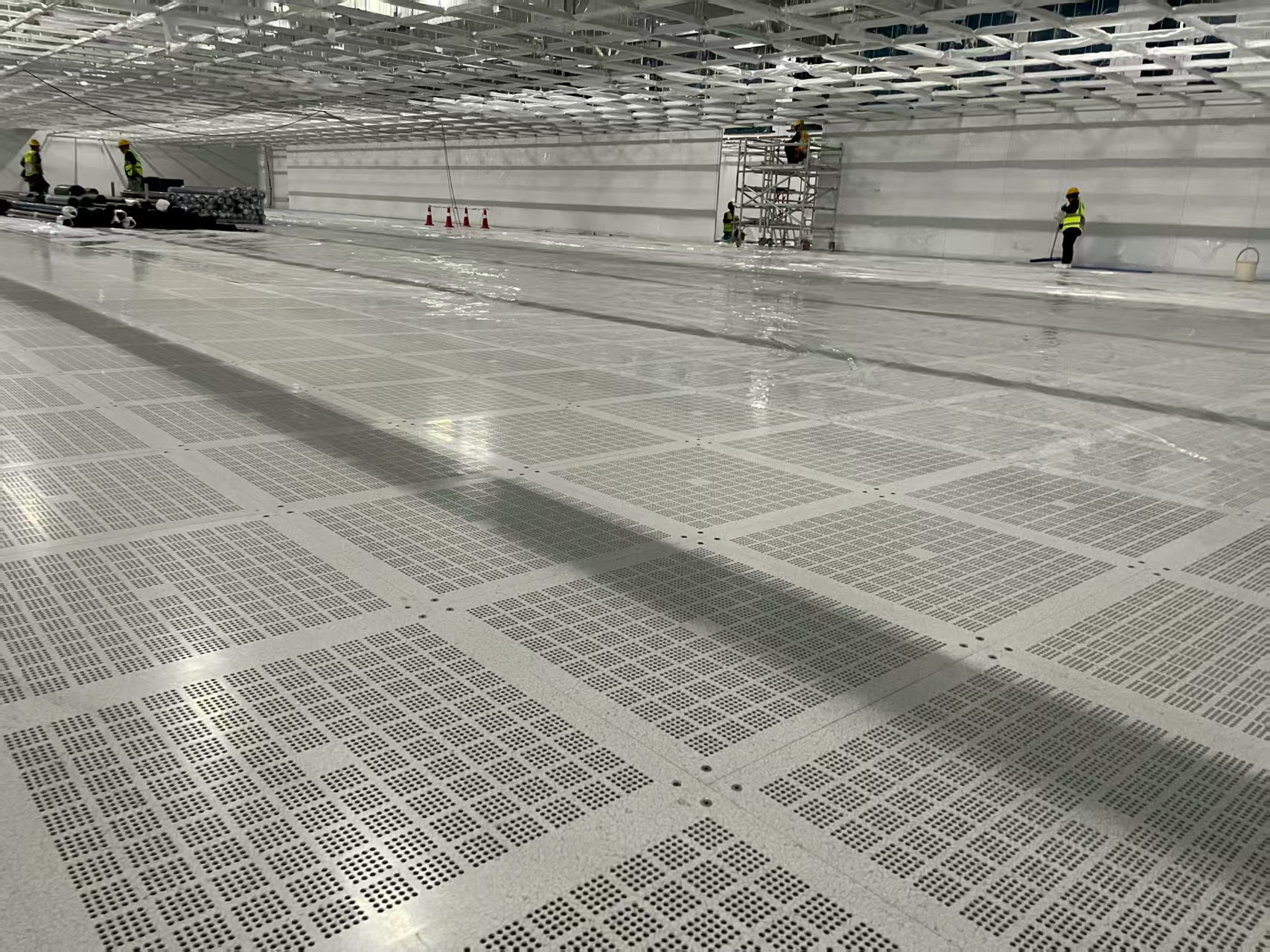
Most people see a raised floor panel as a flat square you walk on, but its real story starts with a dense aluminum billet sitting in a foundry queue. The billet gets sectioned and preheated before being fed into a melt furnace, where it turns into a controlled, degassed alloy. From there, a measured shot of molten aluminum is forced into a steel die under intense pressure—the same way many precision automotive parts are born.
Once the casting solidifies and the die opens, the raw panel is still far from finished. Robots or operators pull it out, knock off the sprue and flash, then run it through a cooling rack. Next come the noisy steps: shot blasting to clean the surface, CNC machining for flatness and edge tolerance, and drilling for pedestal attachment points. Every panel gets checked for thickness and flatness before it earns a coating.
Finally, the panel heads to a powder coat line or an epoxy dip, depending on the order. After curing, it may receive a conductive or anti-static finish, then it's stacked, wrapped, and shipped to a data center or office build-out. The whole trip from billet to raised floor panel often takes less than a week, but each journey leaves the panel ready to carry heavy loads, manage airflow, and stay quiet underfoot.
How Custom Cutouts and Finishes Solve Tricky Lab Layouts
Tricky lab layouts often come down to a few stubborn inches: a support column hogging the corner, a sink that forces the balance table too close to the door. Custom cutouts let you carve around those obstacles without pushing the whole bench off-axis. A notch for a drain pipe here, a routed channel for data cables there, and the work surface still reads as one continuous line.
Finishes do the quiet work of keeping those compromises safe. A textured edge can hide a rough cut so it doesn't snag gloves, while a chemical-grade top coat protects the exposed plywood around a new sink cutout. When the layout gets weird, it's the finish that makes the modification look intentional rather than improvised.
The payoff shows up in day-to-day movement. Technicians stop doing that half-step shuffle around a protruding gas valve, and the fume hood's awkward clearance stops collecting boxes. Custom cutouts and finishes don't change the floor plan; they make the floor plan livable.
The Export Checklist Every Buyer Should Review Before Ordering
Before committing to an export order, a buyer needs to verify that the product meets not only the destination country's mandatory standards but also any niche requirements that may not appear in generic supplier catalogs. One overlooked certification or a mismatch in voltage, labeling, or material composition can turn a straightforward shipment into a costly customs hold or a full rejection at the port. Rather than relying on the supplier's word, cross-check each specification against the actual regulatory database of the importing country, and keep a dated record of every confirmation.
Packaging and documentation often cause more export delays than the product itself. Weight declarations, harmonized system codes, and invoice details must align exactly with what is physically loaded into the container. Even small discrepancies, like a missing country-of-origin mark on the inner carton or an outdated incoterm on the bill of lading, can trigger inspection fees and storage charges. Spend time reviewing a completed sample of the shipping paperwork alongside a physical sample of the packaged goods, then have someone who was not involved in the preparation double-check the numbers.
Finally, clarify the payment and inspection timeline before any money moves. A proper export checklist includes when and how the goods will be checked by a third party, what constitutes a failed inspection, and who bears the cost of rework or replacement if defects are found. Without these terms written into the purchase order, a buyer may discover too late that a deposit has been paid but the factory has no contractual obligation to fix latent issues discovered after dispatch. Treat the checklist not as a formality but as the only reliable map through the export process.
Long-Term Performance Data from Sensitive Environments
Collecting performance data over extended periods in sensitive environments presents a distinct set of challenges that typical laboratory or controlled-site testing rarely addresses. Equipment deployed in coastal zones, high-humidity tropical forests, or subarctic installations contends with salt spray, fungal growth, extreme temperature swings, and UV degradation simultaneously. Unlike short-term accelerated aging tests that extrapolate results from a few weeks of stress, years of field exposure reveal how materials interact with local microclimates, seasonal cycles, and unpredictable events like sandstorms or ice accumulation. The resulting datasets often expose failure modes that no benchtop simulation could predict, such as gradual seal embrittlement from ozone combined with thermal cycling, or corrosion initiating at microscopic surface defects that only become apparent after multiple wet-dry transitions.
One of the most valuable aspects of this long-term field data is its ability to recalibrate lifetime predictions for components used in critical infrastructure or remote monitoring systems. A coating that looks pristine after 2,000 hours of salt spray testing may show measurable adhesion loss after five years on an actual offshore platform. Similarly, polymer housings that survive accelerated UV chambers can develop microcracking in real sunlight because natural spectral distribution and moisture exposure differ from artificial sources. Engineers who incorporate multi-year performance records from these demanding locations can adjust safety factors, refine maintenance schedules, and select materials with proven rather than projected durability. The data also highlights regional variability: the same enclosure model might last over a decade in a dry desert but require replacement within four years on a humid coastline.
Long-term datasets from sensitive environments also serve as a reality check for newer accelerated testing methodologies. When field results diverge from laboratory predictions, it forces a reexamination of test parameters such as irradiance intensity, condensation cycles, or pollutant concentrations. Over time, these comparisons help develop more accurate predictive models that account for synergistic effects—like wind-driven rain combined with industrial particulates—that are rarely replicated in controlled chambers. Sharing this hard-won field evidence across industries improves material selection for everything from weather station housings to underwater sensor cables, ultimately reducing unexpected failures and the costly maintenance trips required to service equipment in remote or ecologically fragile areas.
Static Control Beyond the Surface: The Science Inside Aluminum Panels
Aluminum panels often get praised for their clean look, but their real value lies in how they handle static on a molecular level. The oxide layer that naturally forms on aluminum isn't just a passive skin—it actively influences charge distribution across the panel. By tuning the thickness and porosity of this layer during anodizing, manufacturers can shift the surface resistivity into a range that slowly drains static instead of letting it snap into a sudden discharge. This is why two panels that look identical under showroom lights can behave completely differently on a production floor.
Deeper inside the panel, the alloy composition plays a quieter but equally critical role. Trace elements like magnesium or silicon alter how electrons move through the bulk material, creating tiny gradients that pull static away from high-friction zones. In practice, a 5052 alloy panel will feel "calmer" to the touch after repeated wiping than a 6061 panel, even if both are coated with the same finish. That difference isn't marketing—it's the result of electron mobility paths being reshaped by the metal's internal grain structure.
The trick that few spec sheets mention is that static control on aluminum is never a single-layer fix. It's a sandwich of behaviors: the top oxide film slows discharge, the underlying alloy steers charge sideways, and the mounting system completes the circuit to ground. When any one of these layers is ignored, the panel becomes a capacitor waiting to surprise someone. The best designs treat the entire thickness of the panel as an active participant, not just a pretty face.
FAQ
Aluminum alloy combines strength with low weight, and it can be treated to dissipate static charges safely. That matters in places like labs and server rooms where a random spark could damage equipment or ignite dust.
You'll see it in electronics manufacturing, data centers, pharmaceutical cleanrooms, and hospital operating theaters. Any space where static control, easy cleaning, and hidden cable routing matter tends to be a good fit.
The panels sit on adjustable pedestals, so there's a plenum underneath. That makes it easier to run cables, HVAC ducts, or piping below the floor without tearing up the surface. Cleaning also becomes simpler because individual panels can be lifted for access.
Look at the coating or treatment used for static dissipation, the load rating of the panels, and the range of pedestal heights available. Ask for samples or third-party test reports. A dependable exporter should also provide clear packaging and installation guidance.
Yes, most projects involve at least some cutting or trimming. Panels can be produced in different sizes, surface finishes, and edge trims. It's worth confirming whether the exporter offers cutting templates and custom pedestal adjustments for sloped or irregular floors.
Aluminum is lighter and often easier to handle during installation. It also resists corrosion well in humid or chemically active environments. Steel can be cheaper for very high load areas, but aluminum tends to offer a better balance of weight, durability, and static control for cleanrooms and labs.
Reputable suppliers test surface resistance and system resistance according to standards like IEC 61340-4-1 or ANSI/ESD S20.20. The aluminum panels should show stable electrical performance even after repeated cleaning or heavy foot traffic. Ask for the test certificate that matches your required resistance range.
Conclusion
Walk through a semiconductor fab, a biosafety level three lab, or a hospital imaging suite, and the floor beneath your feet is rarely an afterthought. Aluminum alloy panels have quietly replaced steel in these spaces because the alloy itself dissipates charge through its entire cross-section, not just across a painted topcoat. Watch a billet move from extrusion press to CNC line and you'll see the difference: cutouts are machined before any coating touches the metal, so edges stay conductive and corners don't chip. This is why a custom opening for a laser table or a cleanroom pass-through doesn't compromise the static-control path. The chemistry matters too—conversion coatings and epoxy powders bond to aluminum's oxide layer in ways that simply don't happen on galvanized steel.
An exporter's real value shows in the details that don't appear on a standard drawing. A lab may need a radiused corner to match a curved workstation, a non-reflective finish to avoid stray light in an optics room, or a reinforced panel under a robotic arm. The right fabricator can waterjet these without three weeks of back-and-forth. Before any purchase order goes out, smart buyers ask for the full export file: mill certificates for the alloy, a test report showing surface resistivity between one million and one billion ohms, and photos of the actual packaging—not stock images. Facilities that have tracked their raised floors for five or more years report the same pattern: fewer static events, no peeling coatings, and no need to replace panels after equipment reconfiguration. That longevity, not a sales pitch, is what keeps them coming back.
Contact Us
Contact Person: yuki
Email: [email protected]
Tel/WhatsApp: +86 18664390732
Website: https://www.lipinfloor.com/