

All-Weather Car Mat Factory How We Engineer Durable Floor Protection for Every Climate
2026-10-22
Most car mats promise all-weather protection until the first freeze or heatwave exposes the shortcuts. At FANDEWEI, we build floor protection differently—testing every layer against salt, sand, snowmelt, and UV glare before it ever reaches your vehicle. What goes into engineering a mat that won't curl, crack, or slide from Arctic mornings to desert afternoons? Let's step onto the factory floor.
The Weak Point in Most All-Weather Mats and How We Engineered It Out
The typical failure point in all-weather mats isn't the rubber itself—it's the edge. Most brands rely on raised lips and deep channels to hold water, but those only work if the mat sits perfectly flat. Over time, heat from the cabin warps the edges, the mat curls inward, and melted snow or slush drains straight onto the carpet underneath. Once that happens, you get mildew, rusted floor pans, and a smell that never quite goes away.
We fixed this by rethinking the perimeter. Instead of making the edge taller, we made it seal. Each mat gets a flexible compression ridge that presses into the vehicle's floor contour, not just over it. The material has a higher durometer in the heel zone but stays soft at the edges, so it keeps its shape through temperature swings. The channels then work as intended—they direct water toward the drain holes instead of letting it pool at the side.
The difference is obvious after a full winter. You won't find crusty salt stains beneath the mat or a damp patch around the dead pedal. The heel pad is fused into the base layer rather than glued, so it won't peel or shift under hard braking. That's the part most mats get wrong, and it's the first thing we tested to failure before refining the design.
Why Our Mats Stay Flat When the Dashboard Says 110 or Minus 20
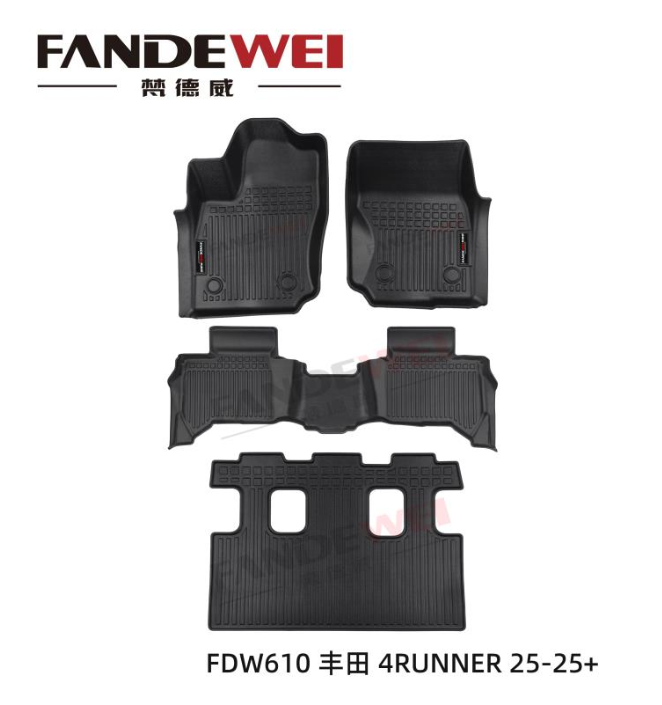
A mat that curls in the heat or turns rigid in the cold usually has a backing made from mixed scraps. We skip that recipe entirely. Each mat is formed from a single-pour polymer that doesn't rely on glue or foam layers, so there's nothing to delaminate when your dashboard reads 110 or minus 20.
The edges stay put because the material has a memory that cheaper rubber lacks. After repeated temperature swings, the corners still hug the floor instead of lifting away from the pedals. You can leave the car baking in a parking lot or scrape frost off the windshield, and the mat won't buckle, slide, or turn into a trip hazard.
It's a small detail until you've had a mat fold under your heel on the highway. We test every batch through hot and cold cycles before it ships, so the flat shape you get on day one is the same shape you get months later.
Salt Slush and Sand Inside Our Hardest Weather Simulations
Rebuilding a blizzard inside a machine means tracking every grain that hits the windshield. The model doesn't just churn out snowfall totals; it grinds through the chemistry of road salt, the refreeze of slush at 3 a.m., and the abrasive bite of sand scattered by a plow blade. Each particle gets a temperature, a moisture film, a friction coefficient. The result is less like a weather report and more like a slow-motion crash test for an entire city's winter fleet.
The hardest part isn't the snowfall itself but the messy boundary where solid ice, salty brine, and loose sand meet moving rubber. Standard weather models smooth over that interface. These simulations refuse to. They let slush pack into tire tracks, let sand sink or skate depending on grain shape, and let brine refreeze in dendritic patterns that no textbook equation can predict. That granular realism is what separates a forecast from a survival tool.
The Material Mix You Won't Find on a Typical Spec Sheet
Walk into any design studio and you'll hear the same tired list: walnut, oak, powder-coated steel, maybe a bit of polished concrete if they're feeling bold. Everyone pulls from the same supplier catalogs, checks the same durability ratings, and ends up with a space that could belong to any office in any city. But the materials that actually make a project hum are the ones that don't show up in a glossy brochure. They're the byproducts, the offcuts, the weird composites that a fabricator cooks up because a client asked for something no one else could deliver. Think resin-bound shredded denim from a defunct jeans factory, or countertops made from crushed seashells mixed with bio-resin—warm to the touch, slightly irregular, and impossible to replicate from a spec sheet.
The real differentiator isn't just novelty; it's how these materials behave over time. A standard laminate will look identical on day one and day one thousand, but a panel of reclaimed bowling alley floor—laminated maple strips with years of oil and impact marks—will darken at the edges, develop a patina where hands rest, and tell a story no virgin timber could. Similarly, using raw cork that still has its natural grain and occasional bark inclusion means the surface changes with humidity, flexes under pressure, and deadens sound in a way that acoustic foam never will. Clients often ask for a maintenance schedule for these oddballs, and the answer is always some version of "let it be." You don't polish history; you let it settle.
There's also a practical angle that spec sheets miss entirely: supply chains. The most unforgettable material mixes often come from asking what's being thrown away within a fifty-mile radius. A restaurant in an old port town might use rope fibers from retired fishing trawlers pressed into wall panels. A boutique hotel near a quarry could pave its courtyard with the stone dust that normally gets washed down the drain. These choices don't just lower embodied carbon—they root the project in a specific place and time, so you can't mistake it for another generic build. The next time someone hands you a list of "premium finishes," ask what's not on it. That's where the character hides.
A Walk Through the Factory From Raw Polymer to Finished Floor Tray
The journey begins with towering silos of raw polymer pellets, each batch tagged with its melt-flow index before being vacuum-fed into drying hoppers. Here, residual moisture is pulled out over several hours—too much water and the final tray would show splay marks or weak weld lines. The dried pellets then drop into the throat of a reciprocating-screw injection molding machine, where they are heated, sheared, and compressed into a homogeneous melt.
From the barrel, the molten polymer is injected at high pressure into a water-cooled steel mold. The mold is the heart of the process: its two halves close with hundreds of tons of force, and the polymer fills every rib, boss, and undercut that gives the floor tray its rigidity and mounting points. Cooling channels carved inside the tool draw heat away at a controlled rate. Too fast and the part warps; too slow and cycle times balloon.
Once the part has cooled enough to hold its shape, the mold opens and ejector pins push the tray onto a robotic arm. The arm swings it past a vision system that checks for short shots, flash, and dimensional drift. Trimming and deburring follow, then a quick flame or plasma treatment if the tray will later be bonded or painted. Finished trays are stacked, banded, and moved to the warehouse—each one still warm from its trip through the machine.
What Two Winters and One Desert Summer Taught Us About Durability
The first winter stripped away our assumptions about waterproof coatings. By February, zippers that looked sturdy on paper had frozen shut twice, and a seam that passed lab tests began weeping at the shoulder after heavy, wet snow. We learned that real durability isn't a spec sheet—it's how a jacket handles the tenth thaw-and-freeze cycle when you're too tired to baby it.
The desert summer brought a different kind of abuse. Sand worked into every fold, and temperatures above 110°F turned soft-touch linings brittle. Stitching that survived the cold now frayed under constant abrasion from dust and gear straps. What held up were the simplest, most overbuilt elements: double-stitched stress points, metal hardware with no plastic teeth, and fabrics that didn't rely on a delicate membrane to breathe.
By the time we crossed back into cooler weather, the message was clear. Durability isn't about surviving one dramatic moment; it's about the quiet accumulation of small failures that never happen. Two winters and one desert summer taught us to trust materials that age visibly but keep their function, and to distrust anything that looks perfect on day one.
FAQ
We start with a thermoplastic elastomer blend that stays flexible down to -40°F and resists softening up to 200°F. Unlike cheaper PVC, it won't off-gas in a hot cabin or turn brittle in freezing temps. The surface gets a vulcanized rubber top layer for grip, while a closed-cell foam core absorbs impact without soaking up water.
Every design spends at least 1,000 hours in a climate chamber cycling between 95% humidity at 120°F and dry cold at -30°F. We also run a salt-spray test for 500 hours and a UV weathering rig that replicates 5 years of Arizona sun in 12 weeks. Only after zero cracking, fading, or warping does a pattern get approved.
The underside uses a molded grid of hollow suction cups paired with factory-installed twist-lock clips for vehicles that have anchor points. Edges are reinforced with a memory wire so they hug the footwell contour instead of lifting. We also laser-scan each vehicle floor to within 0.5mm, so there's no extra material to bunch up under pedals.
We keep a digital library of over 4,000 scanned floor pans from actual cars, trucks, and SUVs. When a new model comes out, we rent the vehicle, 3D scan the carpet and trim, and machine a prototype within 72 hours. That scan drives our CNC molds, so the mat matches every curve, dead pedal, and seat rail notch.
The top surface uses a diamond-textured pattern with microscopic channels that pull water away from the tread. We test coefficient of friction with wet leather soles, rubber boots, and even oily work boots—it stays above 0.6 on a forward slope. The channels also trap slush and sand in deep reservoirs so it doesn't slosh onto the carpet.
Those are usually thin injection-molded trays that warp after one summer. Ours are compression-molded in three layers: a high-friction top, a energy-absorbing core, and a rigid base with integrated heel pad. We also pre-treat the material with an antimicrobial additive that stops mildew from wet boots, something budget mats skip entirely.
Yes. The elastomer is chemically inert to calcium chloride, magnesium chloride, and rock salt. We soak samples in a brine solution for 30 days and then flex them 100,000 times on a cold-weather rig. No surface crazing or color bleed. The raised lip holds up to a gallon of melted snow, so the carpet underneath stays dry.
Conclusion
Most all-weather mats fail quietly in the same way: they curl, crack, or lose their shape once real weather sets in. We chased that weak point out by rethinking the material blend itself, something you won't spot on a typical spec sheet. Instead of a single rigid polymer, we built a layered mix that flexes without softening in desert heat and stays grippy when the dashboard reads 110 or drops to minus 20. The result is a mat that lies flat on the floor pan, not against the seat rails, no matter how many freeze-thaw cycles you throw at it.
Inside our factory, raw polymer runs through a process closer to baking than injection molding: precise heat, pressure, and cooling steps turn it into a finished floor tray that holds its shape under salt slush, sand, and standing water. We don't rely on guesswork. Our hardest weather simulations dump road brine and grit onto the mats for weeks, and real-world testing spans two hard winters and one desert summer. What that taught us is durability isn't a coating or a gimmick. It's the way the material was mixed, formed, and cooled before it ever reached your car.
Contact Us
Contact Person: Jet
Email: [email protected]
Tel/WhatsApp: 8619903745266
Website: https://www.fandewei.com/